All in the <head>

– Ponderings & code by Drew McLellan –

– Live from The Internets since 2003 –

About

Form Elements in Firefox

12 February 2004

Is it just me, or have form elements in the 0.8 release of Firefox for OS X taken an exceptional dive in quality? In particular, radio buttons look simply shocking – like something out of the 1980s.
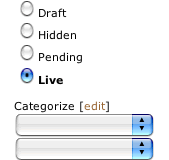
Compare and contrast these two screenshots. The first is of a fragment on the Textpattern web interface in Safari 1.2, and the second is the same region as displayed in the latest release of Firefox (0.8). The third screenshot is of the region in Camino 0.7 – another Mozilla browser.
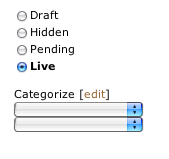
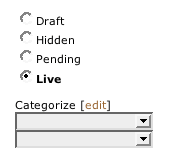
The first obvious difference is that Safari uses the operating system’s native interface widgets. This seems to be the preferred way of working, with more and more browsers opting to display form elements this way rather than attempting their own representation. With a project as large and catering to as many platforms as Mozilla does, it’s obvious why they’re using their own form elements for the time being at least.

What isn’t initially so apparent is that Safari is using the OS X mini form controls. These are compact, scaled down versions of the standard interface elements that can be used when space is tight. It’s my understanding that Safari selectively applies these based on font size. This not only makes it easier for a designer to work with forms in a small space, it also makes it easier for the user as the interface elements are specifically designed to work in said small spaces. Compare this to Camino, which uses native OS X interface elements, but not the the mini controls that Safari is able to utilize. The difference is marked, and the benefit of the mini controls becomes apparent.

Anyway, the real point of the matter is those radio buttons in Firefox. Just look at them – what a mess! Is this a problem with my system, or do they look like that for everyone? They certainly look fine on Windows.

- Drew McLellan

Comments

  1. § Nathan Pitman: You mean Safari don’t you?
  2. § Lonnie Olson: I just installed Firefox on my Linux box and the form controls use my window manager widgets as expected.
  3. § DD: Was this a problem in Firebird 0.7?
  4. § Nis Sarup: I wondered about the same thing.
    I have just wandered back to Safari after using Firefox for a few days. They are both good, but Firefox is still a beta.
  5. § Tom: Eurgh. What a mess – Mozilla really need to sort this out. They look fine in FireFox/WinXP to me :(
  6. § Jemal: Am I the only one confused? Why are there three images?

    In any case it sounds like it’s time to read Why Mozilla Doesn’t Use Native Widgets again.
  7. § Drew: Jemal – read the text again, I think you caught the page in the few moments between me adding the third image and updating the text.

    Good link – thanks. I understand the reason Moz doesn’t use native widgets, but I don’t understand the reason for using pig-ugly ones.
  8. § Jesse: Pig-ugly … haha.. At least they improved the default look of the app. Looks a lot cleaner, very Safari like – without the ‘getting-old-fast’ brushed metal.
  9. § David House: What can you expect with a Windows-native program running on a Mac? It’s a shame, I know.
  10. § Marco: Firefox windows-native? This is a joke, right?
  11. § Jemal: Drew – if the images are so pig-ugly, have you considered helping out? I understand that this is an open source program and that anybody who wants to can contribute. =-)
  12. § Drew: Jemal – I would help out if I could, but my skill set is that of a web developer, and not that of a software developer.
  13. § Drew: Lots on interesting thoughts on related issues can be found over here.
  14. § Marcus Tucker: When Windows XP came along, I was quite annoyed by IE’s new-found ability to render form elements using the current XP theme, but fortunately not only can users turn this off globally with an option in Tools—>Internet Options—>Advanced, web developers like myself can also tell IE to play nicely by using a HTTP-EQUIV=”MSThemeCompatible” meta tag (or HTTP header if preferred).

    Is there now a standard way of forcing browsers like Firefox and Camino (and IE?) to use old-style rendering? Perhaps it’s implemented as a CSS property?

    If not, surely this is needed to prevent “clever” browsers messing up the appearance of design-centric sites?
  15. § Chris B: The use of native widgets in a browser is a sticky issue.

    What about CSS modification of standard html form inputs?

    Safari and Camino ignore this CSS, leaving the gadgets looking like a Mac OS/X application. Rather than a creation build by the designer.

    This leads to consistency and easy of use. If every form looks different from site to site then won’t that confuse users.

    Both are valid arguments.

    Mozilla uses XUL for its default widget set and for the most part it does looks like Windows gadgets, but AFAIK they are not native windows widgets. XUL support CSS properties ( well mostly )

    Under Linux you can compile FireFox against GTK and get the same effect as Camino but not everything is native, you end up with a sort of hybrid XUL / GTK.

    My suggestion, use the one you like. Pulling up more than one browser is something that web developers do for testing. The average person couldn’t care less.
  16. § mary: Related discussion
    http://www.gurusnetwork.com/discussion/thread/2675/
  17. § mary: crud, sorry for a double-comment here, but can you ‘hide’ my email address above? I don’t want spam. :(
  18. § Drew McLellan: Mary – have done.
  19. § Aet: http://homepage.mac.com/travellers/software/Firefox/aquafirefox_en.html
    http://www.versiontracker.com/dyn/moreinfo/macosx/24768
    It makes the form widgets better. Much better.

Photographs

CSS Training Course: 18th July

We're running another CSS course aimed at beginners (or those wanting to freshen up!) on 18th July. Places are limited, so book soon to be sure of a place.

Work With Me

edgeofmyseat.com logo

At edgeofmyseat.com we build custom content management systems, ecommerce solutions and develop web apps.

Recent Links

Affiliation

  • Web Standards Project
  • Britpack
  • 24 ways

About Drew McLellan

Photo of Drew McLellan

Drew McLellan has been hacking on the web since around 1996 following an unfortunate incident with a margarine tub. Since then he’s spread himself between both front- and back-end development projects, and now is Director and Senior Web Developer at edgeofmyseat.com in Maidenhead, UK (GEO: 51.5217, -0.7177). Prior to this, Drew was a Web Developer for Yahoo!, and before that primarily worked as a technical lead within design and branding agencies for clients such as Nissan, Goodyear Dunlop, Siemens/Bosch, Caburys, ICI Dulux and Virgin.net. Somewhere along the way, Drew managed to get himself embroiled with Dreamweaver and was made an early Macromedia Evangelist for that product. This lead to book deals, public appearances, fame, glory, and his eventual downfall.

Picking himself up again, Drew is now a strong advocate for best practises, and stood as Group Lead for The Web Standards Project 2006-08. He has had articles published by A List Apart, Adobe, and O’Reilly Media’s XML.com, mostly due to mistaken identity. Drew is a proponent of the lower-case semantic web, and is currently expending energies in the direction of the microformats movement, with particular interests in making parsers an off-the-shelf commodity and developing simple UI conventions. He writes here at all in the head and, with a little help from his friends, at 24 ways.