Impressions of The New AirPort Extreme
I moved house recently and, as often happens, the new place is a bit bigger than the old. In addition, the change in layout meant that our work area was no longer physically close the incoming phone line and hence the ADSL. This resulted in a few challenges in terms of our existing wireless network configuration, and brought about the perfect opportunity to buy some new shiny Apple gear. Cue: the new Apple AirPort Extreme.
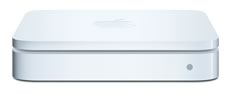 I’d previously been using a pair of AirPort Expresses, with one as the main base station and the other being used to extend the range of the first. As the layout of the new place isn’t so compact, I just needed to push the range out further, whilst still keeping one of the Express base stations in our office to make use of AirTunes.
So today I popped along to St Steve’s Cathedral on Regent Street and picked up (which is a casual phrase implying purchase) a new base station. I got the new Airport Extreme home and set it up. The new software is excellent, although transitioning from the existing configuration took some figuring out.
The way it used to work was that you’d set the first base station up as normal. You’d then add the second by specifying the same network name and checking a box that said something along the lines of using this one to extend an existing network, and you were done.
Now it’s a lot more comprehensive. Firstly, Apple have adopted the WDS (wireless distribution system) nomenclature with its Main, Remote and Relay base stations. It’s all rather more formal, and each base station acting as a ‘main’ or ‘relay’ needs to hold a list of MAC addresses of base stations that are allowed to act as relays or remotes for it. This has to be reciprocated, with each relay or remote base station specifying the MAC address of the base it should look to for a signal.
All seems very robust, logical and more secure than the previous system, but moving from one to the other without particular knowledge of how WDS formally works resorted in a good few minutes of needing to RTFM.
Once I’d got it figured out though, it seems to work nicely. Huzzah! The Extreme base station is a lovely, lovely thing. I hooked a printer up to it and It Just Worked, which was nice. The printer showed up via Bonjour and prints quickly (a stark contrast to the Belkin wireless print server I was using before).
So now I have the Extreme hooked up next to the ADSL router down in our server room. Almost directly up on the first floor is our office, which has an Express repeating the signal and pumping iTunes into the hifi.
Then in the spare room at the back of the house I have another Express repeating the signal to complete the coverage. This will hopefully also prove useful when we have guests to stay – even if they can’t get on the wireless, the Express has an ethernet port that will get them up and running. (Yes Mike and your awkward Linux wireless drivers, I mean you).
The other feature I’m really interested in is the USB disk sharing capability. We have a local linux server with RAID and samba shares which does us well for network storage, but I get the feeling that having the option of a dedicated Mac OS formatted drive shared on the network could be really handy. Especially with the small person using her Mac a lot more for school work and recreation. Plus, you know, it’s shiny.